Quantum Coherence Technologies

Coherence-Guided Stabilization

CGS — Coherence-Guided Stabilization

Quantum circuits degrade. The deeper you go, the more noise accumulates, the less reliable the output. Different platforms, same struggle.

CGS is a software protocol that mitigates it.

No hardware modification required
97–99%
Variance Reduction
3
Hardware Platforms
2,000
Gates — Stable
1.5:1
Qubit Overhead

Quantum Systems Drift

As circuits get deeper, accumulated noise causes results to become unpredictable — forcing teams to limit circuit depth, multiply shot counts, or accept unreliable output. Every quantum platform faces this. CGS addresses it directly, in software, on existing hardware.

High Variance

Run-to-run results fluctuate wildly, requiring excessive shot counts to extract reliable answers.

Depth Limits

Useful algorithms require deep circuits, but coherence degrades rapidly — often within microseconds on superconducting hardware.

Cost Scaling

More shots means more compute time and cost. Unreliable results multiply the expense of every quantum workload.

Hardware-Proven Performance

These are not simulations. CGS has been validated on commercial quantum hardware across three independent architectures — superconducting and trapped-ion. The results are consistent, reproducible, and available on request.
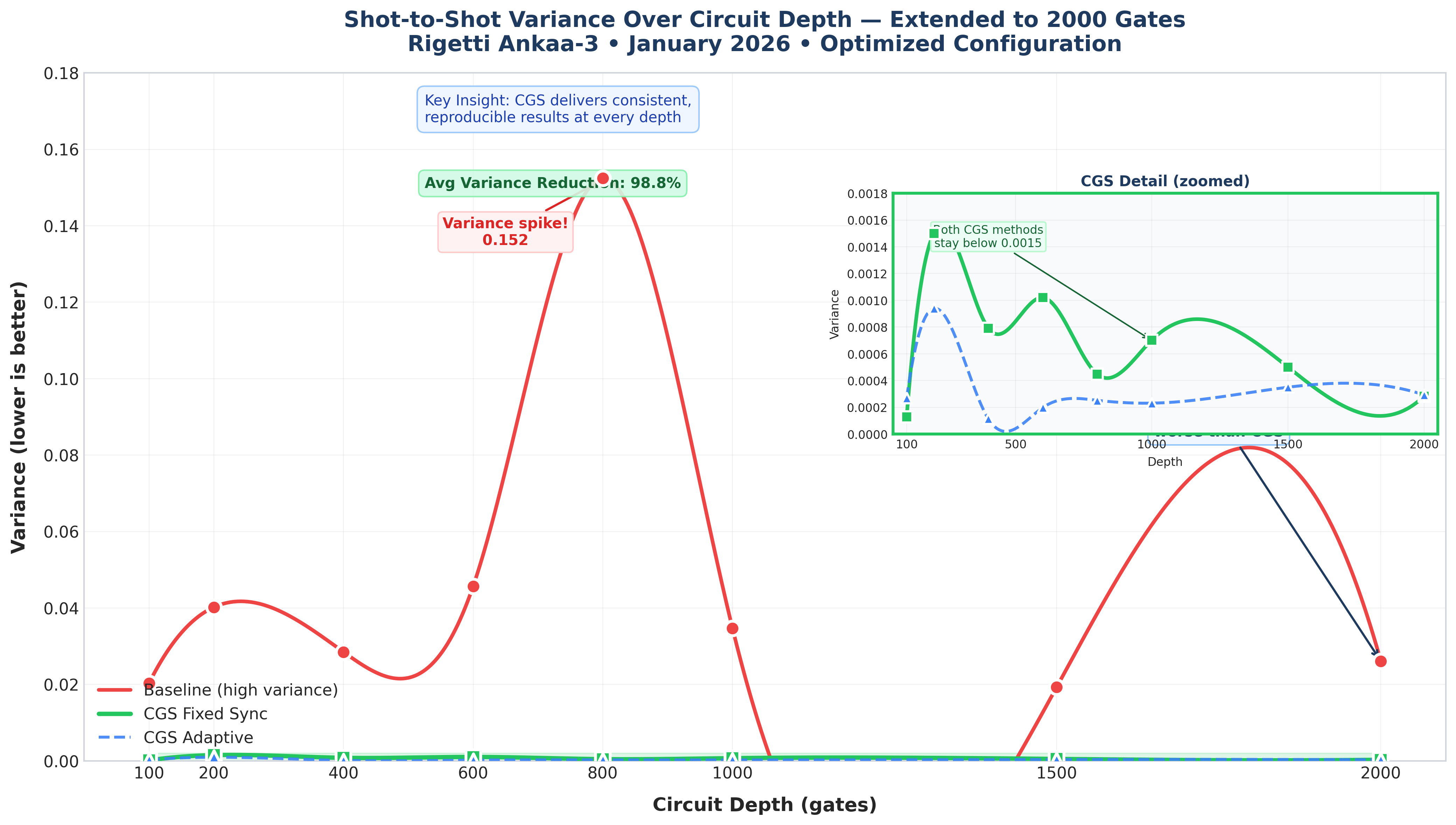
Shot-to-Shot Variance Over Circuit Depth — CGS vs Baseline
Shot-to-shot variance · Rigetti Ankaa-3 · 2,000 gates · CGS stays flat while baseline swings wildly
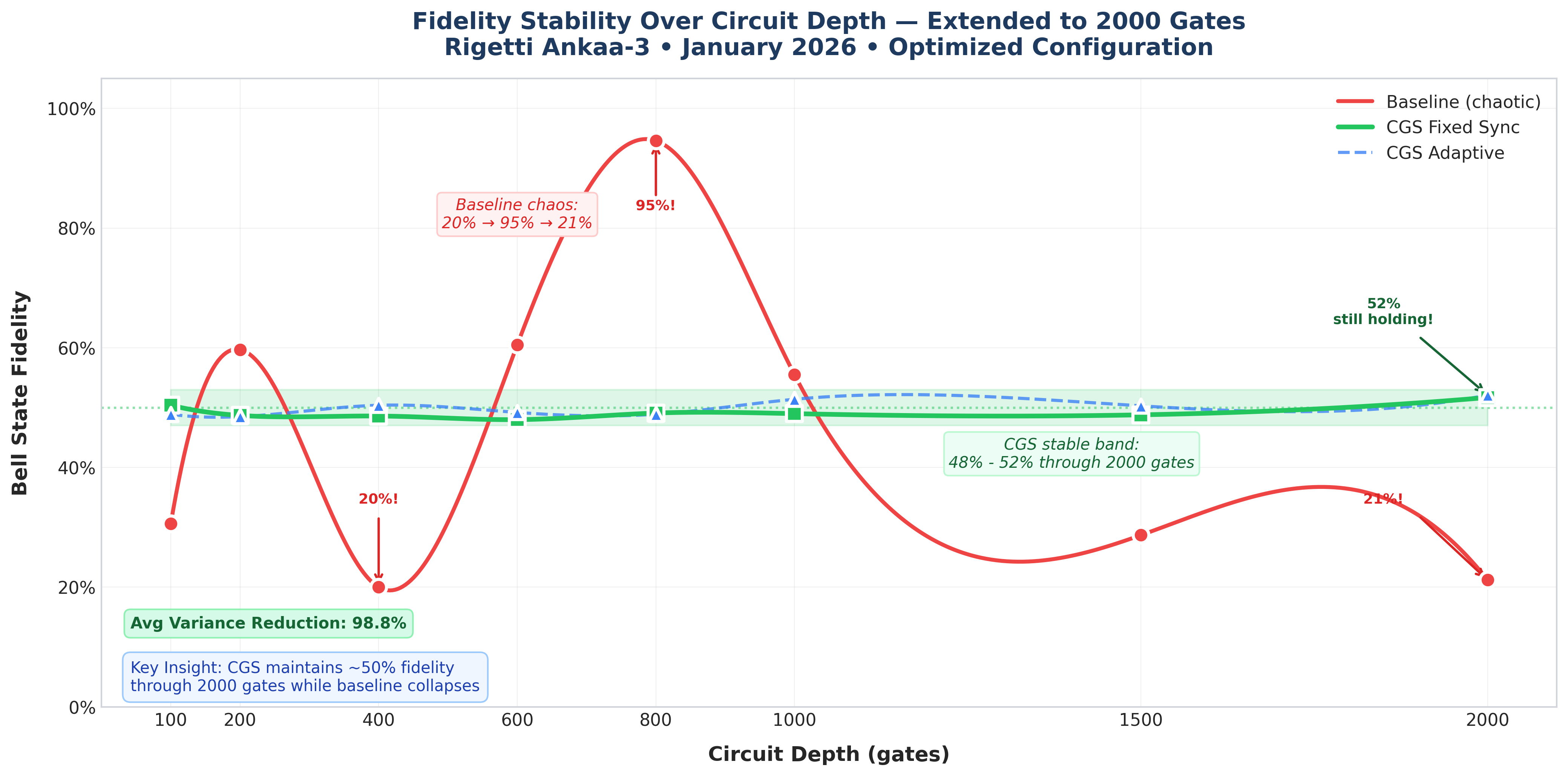
Fidelity Stability Over Circuit Depth — CGS vs Baseline
Fidelity stability · Rigetti Ankaa-3 · 2,000 gates · 98.8% avg variance reduction · Baseline collapses. CGS holds.
Swipe to view full table
Platform Test Qubits Gates Variance Reduction Fidelity (Baseline → CGS)
Rigetti Ankaa-3
Superconducting
Single Triad
Depth Validation
3 2,000 98.8% Baseline: 0.55→0.21 (collapsing)
CGS: 0.49–0.52
(stable band)
IQM Emerald
Superconducting
Frame Sweep
(5 configurations)
3 100 99.6% Baseline: 0.04
CGS: 0.49
(stable band)
IonQ Forte
Trapped-Ion
Cross-Technology
Validation
3 100 97.8% Baseline: 0.84 (high, chaotic)
CGS: 0.53
(stable, low variance)
Rigetti Ankaa-3
Superconducting
3-Triad Scaling
(identical programs)
9 1,000 99.5 / 98.8 / 99.7%
Avg: 99.3%
Baseline: 0.28 / 0.28 / 0.24
CGS: 0.49 / 0.51 / 0.48
Rigetti Ankaa-3
Superconducting
Multi-Program Scaling
(differentiated functions)
9 1,000 99.6 / 99.1 / 98.8%
Avg: 99.2%
Baseline: 0.28 / 0.28 / 0.25
CGS: 0.51 / 0.52 / 0.55

97–99% variance reduction is not a single result. It is a pattern — repeated across superconducting qubits, trapped ions, and five independent test configurations.

Why This Is Significant — T2 Context

Every qubit has a T2 coherence time — the window during which it can hold phase stability before environmental noise takes over. On Rigetti Ankaa-3, the vendor-measured T2 of the most noise-sensitive qubit in the CGS triad is 23.3 microseconds.

At 2,000 gates, CGS is running circuits that execute in 128 microseconds5.5× beyond that T2 limit — while holding 48–52% fidelity and 97–99% variance reduction across every depth tested.

No hardware modification. A 1.5:1 qubit ratio.

What This Means in Practice

1.5:1
qubit overhead

Efficient Architecture

CGS achieves its results with minimal qubit overhead — 9 qubits doing structured work that conventional approaches require orders of magnitude more to attempt.

5.5×
beyond T2 limit

Extended Circuit Depth

Run circuits well beyond each platform's native coherence limit — validated on production hardware, not simulation.

3
platforms validated

Hardware Agnostic

One software protocol. Superconducting and trapped-ion architectures. The same triadic structure adapts to each platform's native timing.

The data is real. The hardware is real. The results are reproducible.

Ready to See It?

CGS is available for licensing to quantum hardware providers, research teams, and enterprise users. Request the data or start a conversation.

Get in Touch